BACK TO RESEARCH WITH IMPACT: FNR HIGHLIGHTS
Since its creation, the FNR has been committed not only to funding excellent research, but also to understanding how funding shapes research itself: where it succeeds, where it can improve, and how it can best serve Luxembourg’s scientific community. This commitment to fairness and continuous improvement led FNR to join the Research on Research Institute (RoRI), a global partnership of funders, universities, and research organisations that studies how research systems operate and evolve.
Within this framework, FNR contributed to one of RoRI’s flagship studies, published recently in eLife, which examined how early-career funding outcomes influence long-term research trajectories through two opposing forces: the Matthew Effect, often described as “the rich get richer and the poor get poorer”; and the early-career setback effect, where early failure may, paradoxically, lead to greater later impact.
Early Funding Outcomes Shape Research Trajectories
Led by Dr Vincent Traag from CWTS Leiden University, the study combined more than 109,000 grant applications from six major funders – Canadian Institutes of Health Research (CIHR); The Austrian Science Fund (FWF) The Social Sciences and Humanities Research Council (SSHRC) Health Research BC, FNR, FWF, and the Wellcome Trust – to examine how early-career success or rejection shapes future outcomes.
Across funders, the results reveal a strong Matthew effect: researchers who received early-career funding were substantially more likely to obtain later grants than those not initially funded.
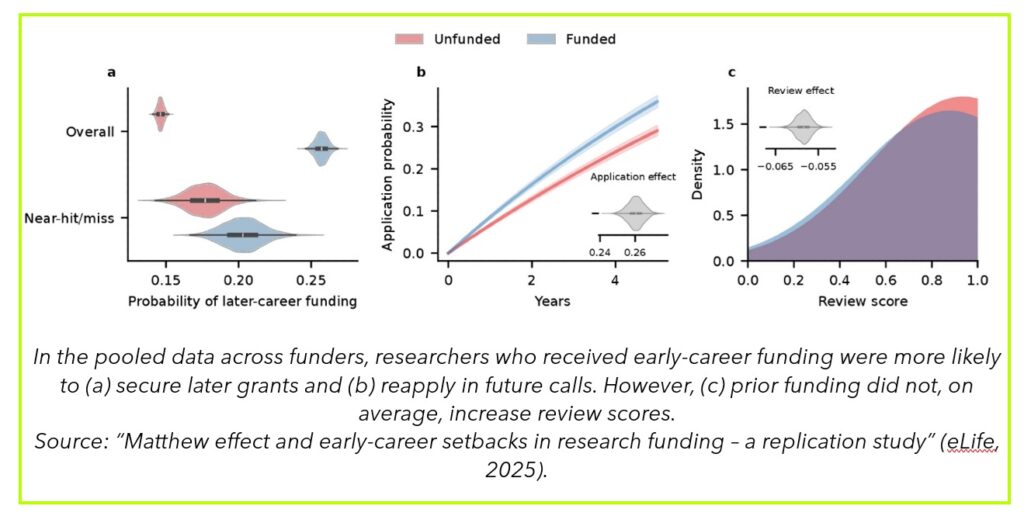
In contrast, the early-career setback effect appeared limited. While some unfunded applicants who later reapplied produced highly cited work, this pattern was confined to specific programmes and is likely driven by selection effects rather than a general causal benefit of early rejection.
In FNR’s case, the Matthew effect also appeared. Among 1,263 applications to the ATTRACT and CORE programmes (2009–2022), early-career researchers who secured initial funding were more likely to obtain later grants. Early-career setbacks were not detected in the programs under review.
Furthermore, Bayesian modelling indicated that prior funding did not translate into higher review scores for FNR applicants. This finding suggests no systematic reviewer preference for previously funded researchers, which is consistent with decisions being driven primarily by proposal quality rather than reputation.
Reflecting on the Findings
The findings of the Matthew Effect study reinforce the importance of maintaining transparent, merit-based evaluation while also recognising the potential of researchers who narrowly miss out on funding. Supporting these “near-miss” applicants through feedback, mentoring, and encouragement to reapply can help retain promising talent and mitigate the cumulative disadvantage that early rejection can create. To this end, the FNR has introduced merit certificates for proposals that were deemed fundable but could not be supported due to budget constraints. This initiative, introduced this year, aligns with recommendations from the study, which emphasize the importance of encouraging promising but initially unsuccessful applicants to remain engaged and reapply.
The study also illustrates how early success can shape future opportunities: while the Matthew effect is robust and general, evidence for an early-career setback effect is limited and appears driven by selection among those who reapply. Understanding these dynamics helps us better appreciate how funding decisions can influence long-term career development.
This work underlines FNR’s ongoing commitment to learn from evidence, collaborate internationally, and continuously reflect on its own practices to provide fair and effective support to the research community.
📋 Read more:
Replication materials are available on Figshare, and the full announcement can be found on the RoRI website. The paper is also featured on the Matthew Project page and the RoRI Resources portal. For highlights and discussions, see the social media communications shared by RoRI and authors on LinkedIn, Mastodon and Bluesky thread.
Authors : Cindy Lopes-Bento | Flavie Bidel (FNR)
Contact: data@fnr.lu
Data Specifications
FNR Data Source: Internal FNR records on applications, panel recommendations, and reviewer scores for the ATTRACT and CORE programmes (2009–2022, 1,263 applications, 511 unique applicants)
Bibliometric data: Publication and citation metrics (Mean Field Citation Rate) were retrieved from Dimensions using the Dimensions API. Each funder collected data internally, matched applicants to Dimensions based on names and affiliations, and extracted publication information through a shared script jointly developed by all funders.
Anonymisation and data sharing: All FNR data were anonymised before being shared via the secure RoRI Funder Data Platform. No information on individual publications or identifiable applicant data was shared.
Related highlights
Three years of Narrative CVs at the FNR: what the data tell us
Feedback from applicants and reviewers (2021–2023) and what we’re researching next Since 2021, the FNR has used narrative CVs as…
Read more
Rising Competition in CORE: A decade of increasing demand, improved proposals and tougher choices
As the 10th April deadline for the 2025 CORE call approaches, we take a moment to reflect on the evolving…
Read more
Taking science to the next level: Towards open, inclusive, forward-looking research culture
As a funder, the FNR’s main job is to make sure the best science gets funded. How these decisions are…
Read more
Spotlight on Young Researchers: How is scientific quality fostered by research collaboration?
In the last decades, how research is conducted has been profoundly changed by ICT, and there has also been a…
Read more