BACK TO RESEARCH WITH IMPACT: FNR HIGHLIGHTS
Complex systems are part of our everyday lives: smart cars, satellites, medical devices – but if they fail it can become dangerous. Researchers are combining AI with formal verification to support engineers in building stronger systems less likely to fail.
Most complex systems are designed through fragile processes, with limited exploration and little safety automation.
“When things go wrong, it’s not just expensive—it’s personal. A rehab exoskeleton that fails can injure someone. A faulty satellite design costs millions. My research tackles this by combining AI with formal verification to help engineers build safer, smarter systems from the start. This matters for industry, public infrastructure, and for the people who depend on these systems to move, communicate, or simply live without fear of failure,” explains Tagir Fabarisov, an AI x Formal Methods scientist and Postdoctoral researcher at the SnT of the University of Luxembourg.
“We’ve moved from trial-and-error to simulation and automated reasoning. In rehabilitation robotics, research like mine enabled low-cost exoskeletons to detect faults early—without needing heavyweight infrastructure. In aerospace and critical systems, formal verification now lets engineers catch design flaws before they become disasters. ”Dr Tagir Fabarisov AI x Formal Methods scientist and Postdoctoral researcher at the SnT of the University of Luxembourg
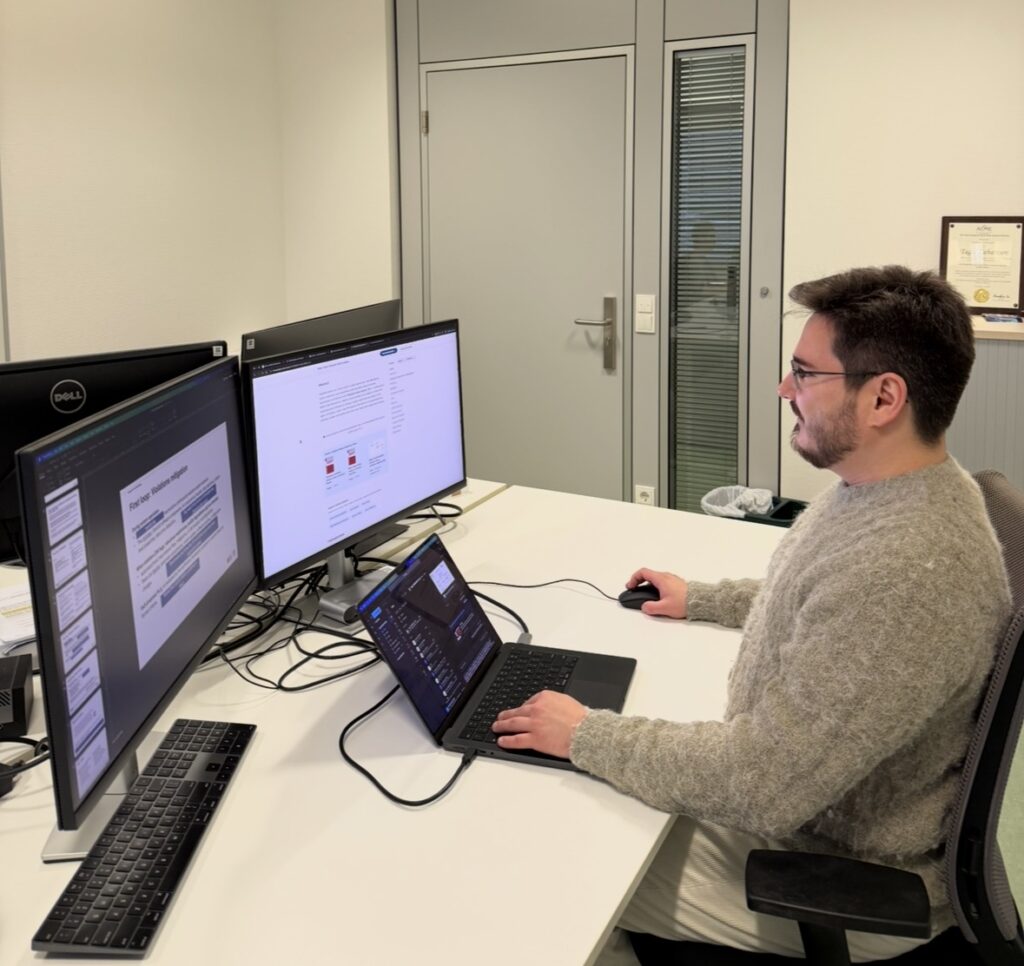
Projects like the FNR-funded CORE project VARIANCE, which Tagir is working on, go further: It combines AI with formal methods to automatically explore safe and efficient architectures.
“We’re proving that performance and trust aren’t mutually exclusive. The tools exist. The breakthroughs are here. What’s changing is how we design—faster, safer, and with much more intelligence built in.”
Tagir explains that a key challenge is making AI-driven system design trustworthy. It is vital to have smart methods that go beyond optimisation and explain themselves—and ones that can be verified. This entails merging formal verification with AI across disciplines.
“The science is there. The real goal isn’t smarter systems. It’s smarter choices.”
But, Tagir explains, research still treats AI and verification as “separate worlds”, with one being fast but unexplainable, and the other being safe but slow.
“What’s missing is real investment in bridging them—through usable tools and interdisciplinary thinking. Luxembourg is uniquely positioned to lead this effort, bringing together science, industry, finance, and policy in one place.”
The tools Tagir is developing aim to explore and evaluate thousands of system designs automatically, all while making sure they meet safety and performance requirements.
“Instead of relying on opaque models or manual guesswork, we build workflows that engineers can trust and audit. My work bridges disciplines: AI for speed, verification for rigour. From satellites to critical infrastructure, the goal is to make intelligent design exploration not just possible, but usable—so that dependable systems can be built faster, with fewer failures, and with safety engineered in from the start.”
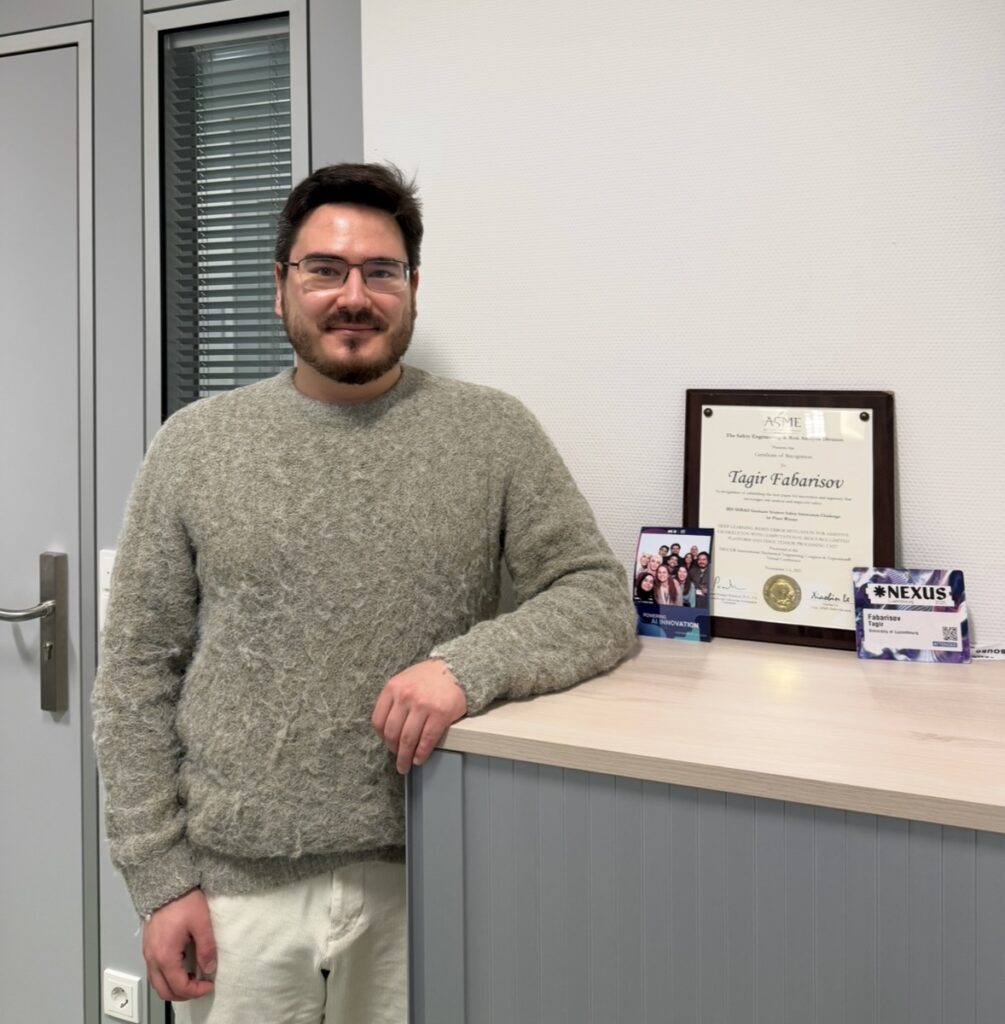
Tagir Fabarisov is an AI x Formal Methods scientist and Postdoctoral researcher working on the CORE project in the SerVal group led by Dr. Maxime Cordy at the SnT of the University of Luxembourg.
Related research papers
Performance Prediction of Cyber-Physical Systems Product Lines in Dynamic Environments
MORE ABOUT TAGIR FABARISOV
Describing his current research in one sentence and more on his background
“I build smart tools that help engineers design safer, more reliable systems—like satellites or medical devices—by combining the speed of AI with the rigour of formal verification.”
“My research is aimed to methodologies that make complex system design both smarter and safer. It started in my PhD studies with improving dependability in lower-limb exoskeletons for elderly rehabilitation—and now continues in postdoctoral research in automated satellite mission planning and designing. In both cases, the goal is the same: systems that perform reliably when real lives depend on them.”
On his research, peer to peer
“My research focuses on integrating formal verification techniques with AI-driven design space exploration to enable the safe and efficient synthesis of complex cyber-physical systems. Within the CORE VARIANCE project, I develop workflows that combine variability modelling, automated architecture generation, and multidisciplinary optimization to support early-stage design decisions. By embedding formal analysis into the exploration loop, the approach enables scalable yet dependable system design—bridging the gap between performance optimization and assurance. Applications include satellite mission planning, but the methodology generalizes to safety-critical domains where traceability, explainability, and trustworthiness are essential from the ground up.”
Impressions of working with industry
“In my experience, working with industry means dealing with strict deadlines, budgets, and certification requirements. Decisions must be practical and fast, even if that means accepting suboptimal solutions. In academia, there is more room to explore, question assumptions, and aim for deeper understanding. In industry, it is critical that methods are usable and results are explainable; theoretical elegance alone is not enough. I value how industry collaboration sharpens priorities: if something cannot scale or be trusted under real conditions, it will not survive beyond a prototype.”
How industry benefits from collaboration with academia and vice versa
“Industry benefits from collaboration by gaining access to new methods, technologies, and perspectives that are not yet available commercially. Public research brings deeper analysis, broader exploration, and long-term thinking that can de-risk innovation. In turn, researchers benefit by confronting real-world constraints, such as limited data, cost pressures, and deployment challenges. This feedback keeps research focused on practical, scalable solutions rather than idealized scenarios. Working together also shortens the path from theory to application, helping both sides build systems that are not only smarter, but truly usable and dependable.”
Mentor with an impact
“Prof. Nafisa Yusupova – she opened the world to students and young researchers by building international partnerships at my alma mater – Ufa State Aviation Technical University. Because of her, an entire wave of scientists and engineers, including me, launched their journeys beyond Russia and into global research careers.”
Related highlights
Spotlight on Young Researchers: Lab-grown Cannabis Sativa for valuable compounds
Cannabis sativa is of great interest to scientists, with uses in areas including cosmetics, nutraceutics and pharma. Researchers are working…
Read more
Spotlight on Young Researchers: Making seawater drinkable
Water covers most of our planet, but only about 3% of it is drinkable and hard to reach for many…
Read more
Spotlight on Young Researchers: Modelling Forest survival in a changing climate
Forests are dynamic ecosystems – they are used to change but it takes time to adapt. Climate change means drastic…
Read more
Spotlight on Young Researchers: Ensuring sustainable water use for Luxembourg
In Luxembourg, nearly one tenth of water consumption happens in agriculture. Changing rainfall patterns and rising irrigation needs during summer…
Read more
Spotlight on Young Researchers – Revisited: From researcher to project manager
When Xianqing Mao was featured in Spotlight on Young Researchers in 2017, she had completed her medical degree and was…
Read more
Spotlight on Young Researchers: Giving robots a more human touch
The use of robots is rising, both in industry and in homes. This is made possible by scientists leveraging artificial…
Read more