BACK TO RESEARCH WITH IMPACT: FNR HIGHLIGHTS
Earlier this year, researchers from Luxembourg fascinated thousands of visitors at the World Expo in Osaka – by presenting an interactive approach combining mathematics with a touch of art and gaming.
The World Expo in Osaka, Japan has recently concluded. During the Summer, researchers from Luxembourg offered a curiosity-stirring activity at three pavilions: Luxembourg, Belgium and Switzerland, reaching over 5,000 visitors. An international endeavour, the activities were a collaboration between researchers from the University of Luxembourg, the University of Liège and the University of Fribourg.
Tied to the PSP-Classic project MandALA (Mathematics and Art to a Large Audience), the researchers set out to promote contemporary mathematics to a wide audience through interactive artistic activities. The goal is to overcome stereotypes by revealing the creativity inherent in mathematics and reaching a family audience across generations. The project focuses on different areas of interaction:
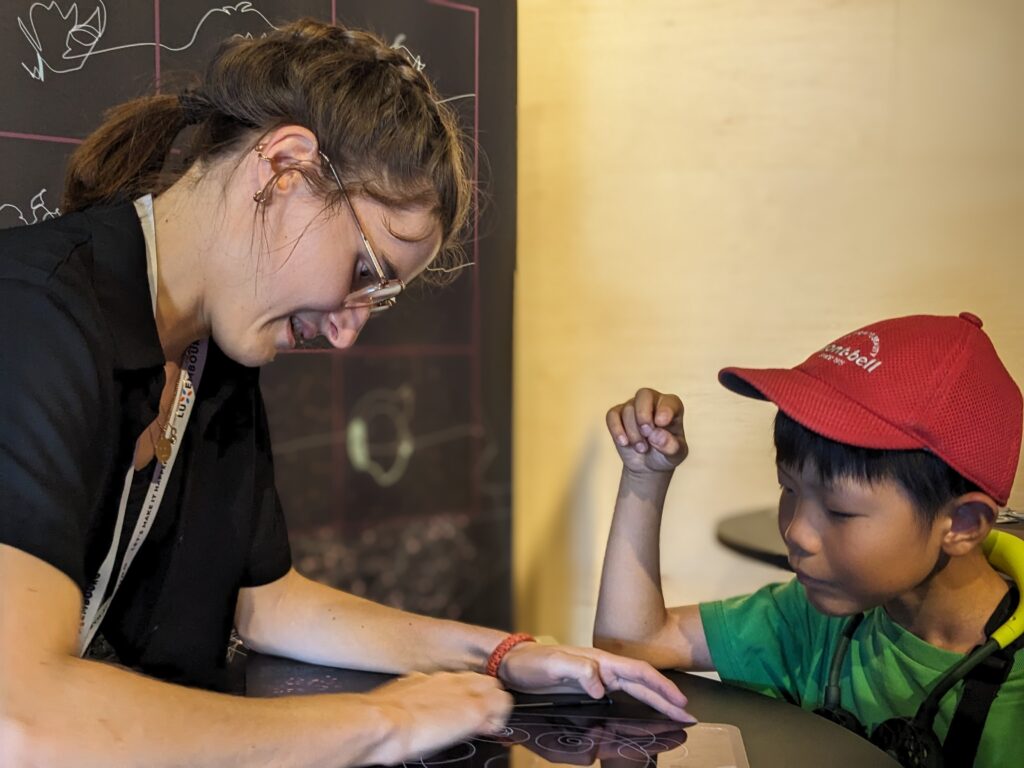
Traces: Participants draw curves on a tablet, which are automatically coloured according to mathematical principles. The collective contributions are showcased through aggregation processes illustrating advanced mathematical concepts.
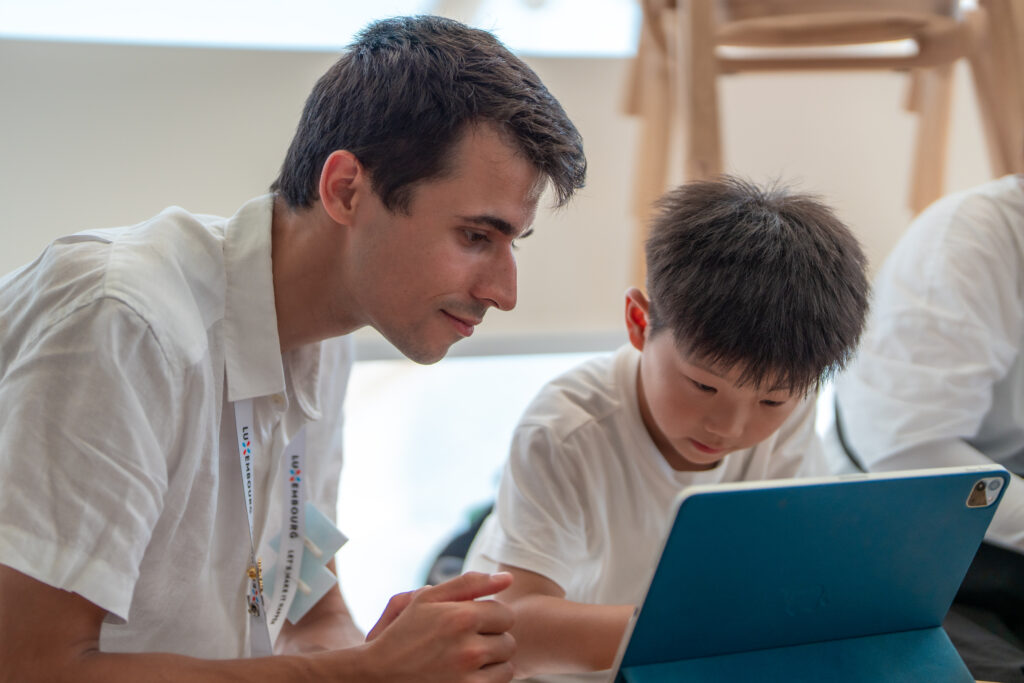
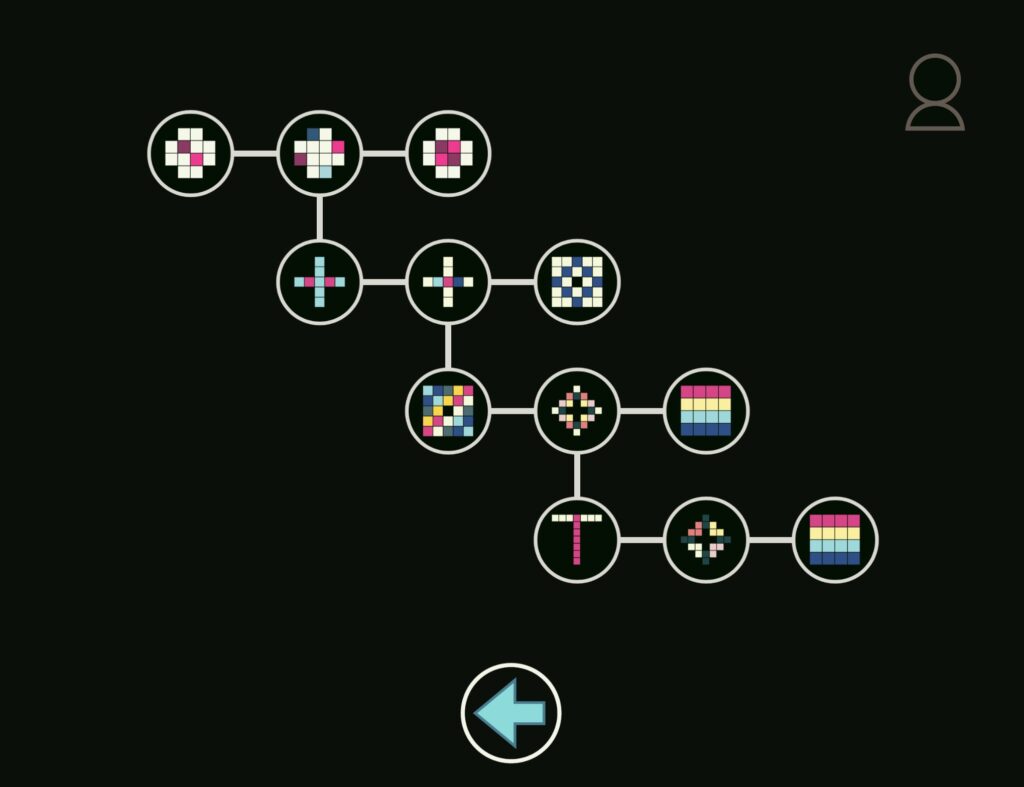
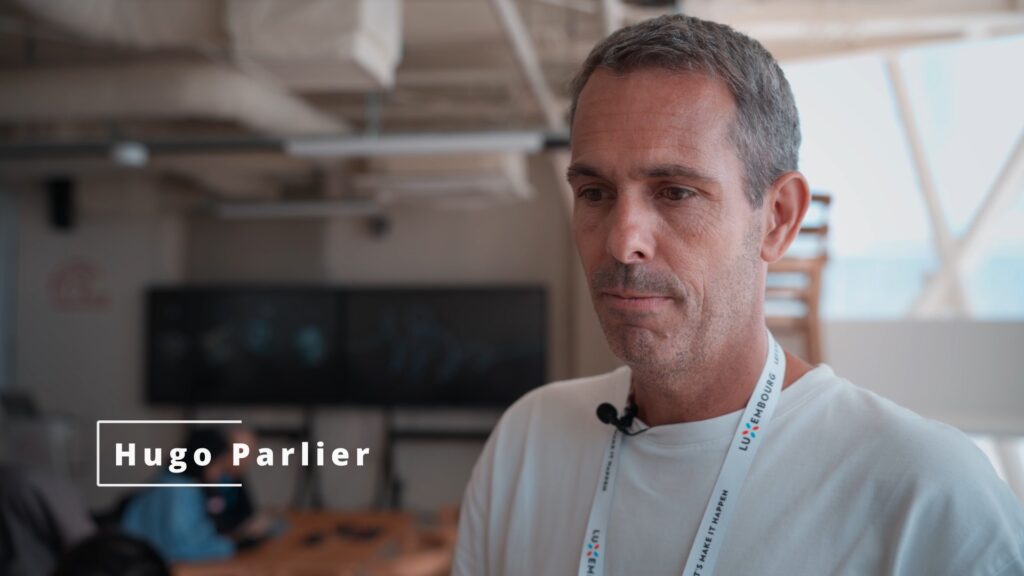
Quadratis, a puzzle game created by Hugo Parlier and Paul Turner, where players are presented with a pattern of square tiles. The tiles are then shuffled and the player has to slide them around in order to restore the original pattern. The game has an element of surprise since the players are essentially using a surface with “topology”, meaning sides are sometimes connected in unsuspecting ways. Ranging from an easy to nearly impossible to solve level, players also have the option to download the games for free.
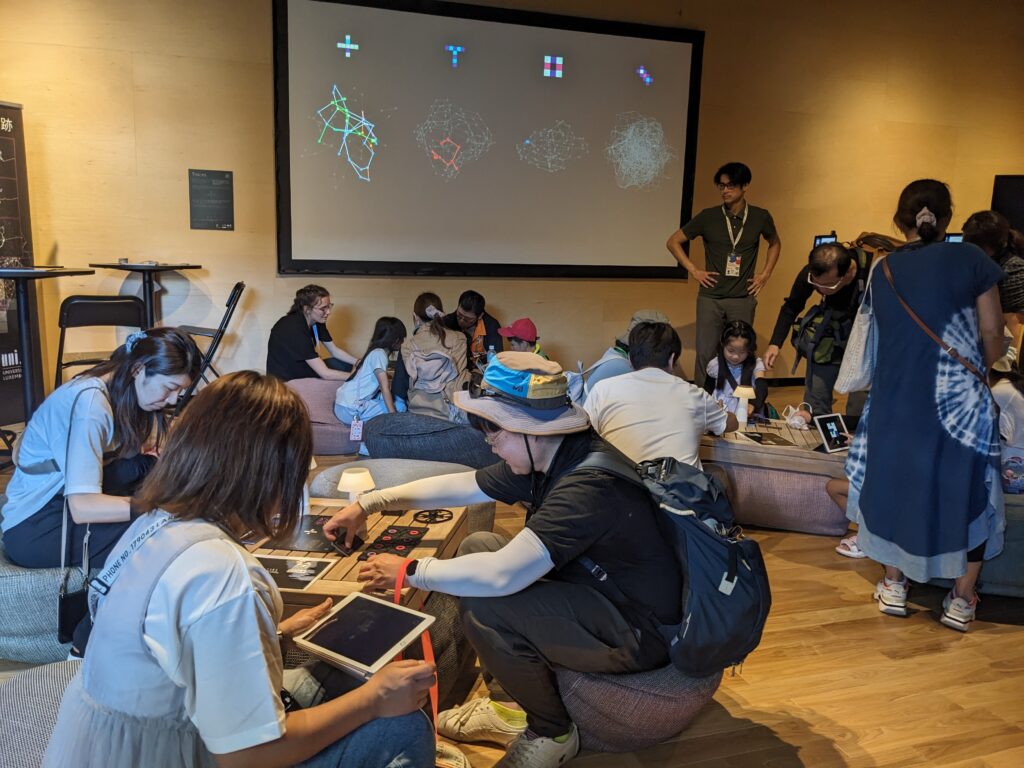
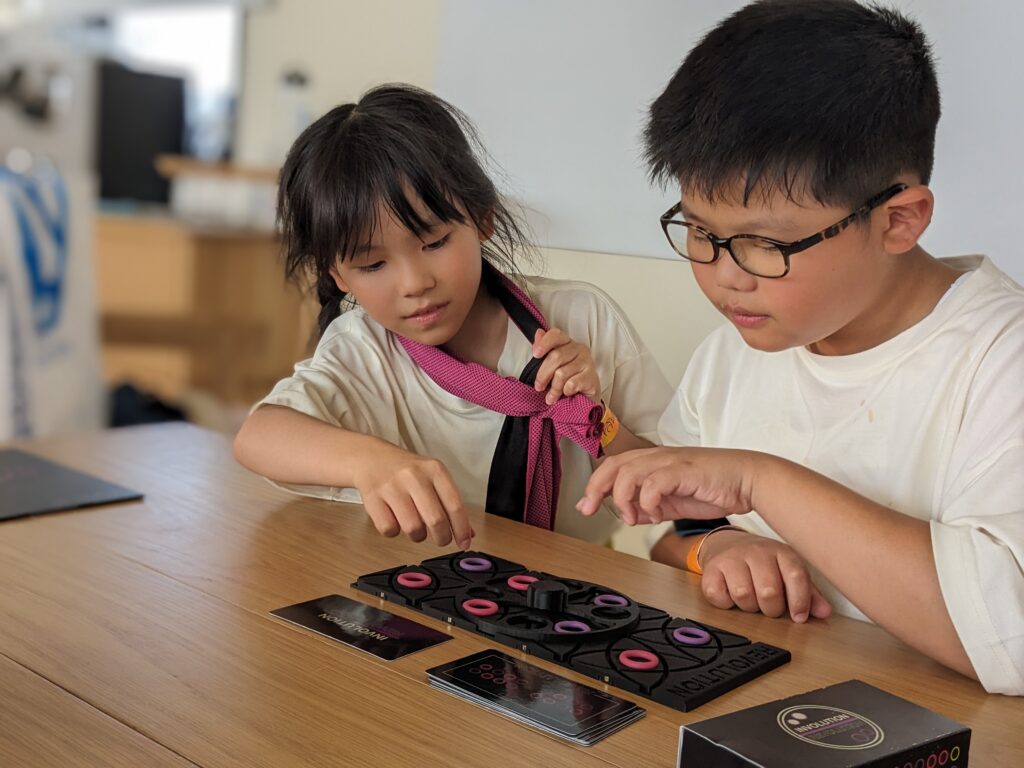
Revolution, created by Bruno Teheux and Hugo Parlier, is similar in the sense that is also revolves around reconfiguration puzzle, but different in the sense that it is played on a physical board. Players have to rotate a wheel in order to move things around. Goal is to find a prescribed sequence of ring patterns, with the puzzles becoming more challenging as the game goes on.
Enabling people to see the creativity of mathematics
The goal is to fascinate people with mathematics, by presenting mathematics as a creative discipline. Contemporary mathematics are brought closer to people through activities that are not usually associated with this discipline – namely art. Maths can be challenging to spark passion for among a wide audience, but this interdisciplinary approach makes it possible as it goes beyond common stereotypes by revealing the inherent creativity of mathematics.
Aside from the World Expo in Osaka, these activities are offered in a wide variety of venues and events, including at “Nuit de la Culture” in Esch, game festivals, and mathematics museums. The tools developed in this context are also used in workshops and interactive popularisation presentations: the public’s work is collected for analysis and processing in real time.
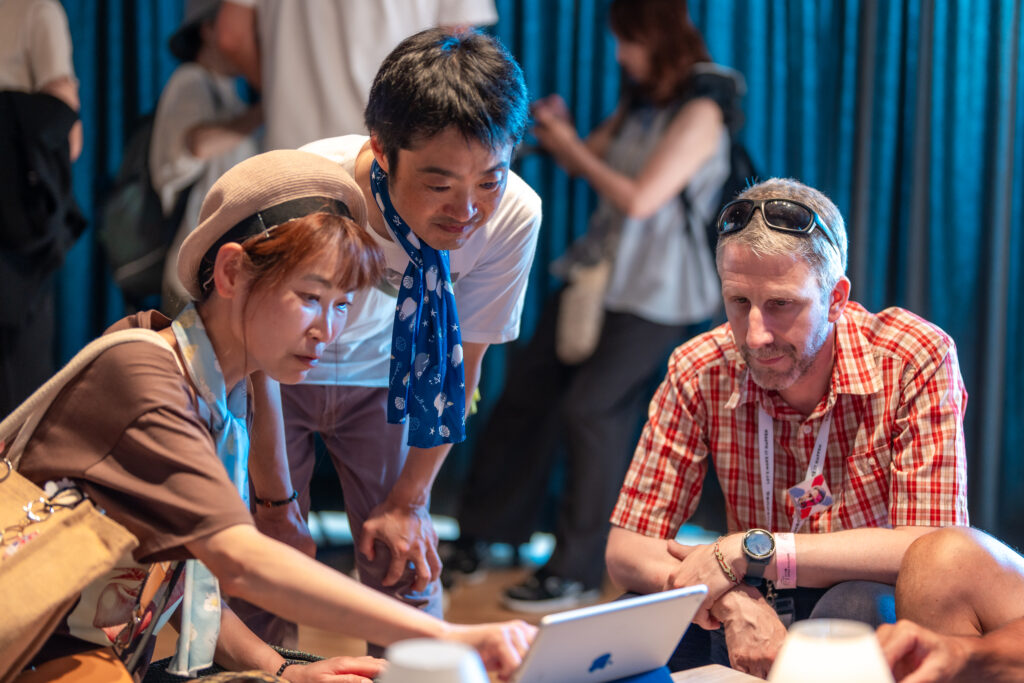
Changing people’s view on mathematics
The researchers who brought this activity to Osaka include Bruno Teheux (Assistant Professor at the Department of Mathematics/ DMATHS of the University of Luxembourg), Hugo Parlier (formerly Professor in Mathematics at the University of Luxembourg, and now working at the Université de Fribourg), as well as Ann Kieffer (LUCET, University of Luxembourg), Laurent Loosveldt, former postdoc in DMATHs and now Assistant Professor a ULiège, as well as Marie Abadie, Bruno Dular and Anne Fisch, PhD students in Mathematics from the University of Luxembourg.
“It was a fantastic opportunity for our PhD students to learn to mediate outreach activities in a different culture, and in three different contexts,” Bruno Teheux explains.
“We came with a team of mediators, mathematicians to propose mathematics activities to people visiting the Luxembourg Pavilion in the World Expo in Osaka, offering activities that connect mathematics, with games or art. The idea is to update people's perspective on mathematics. We have designed all the activities here with Hugo Parlier, my colleague from the University of Fribourg. ”Bruno Teheux University of Luxembourg
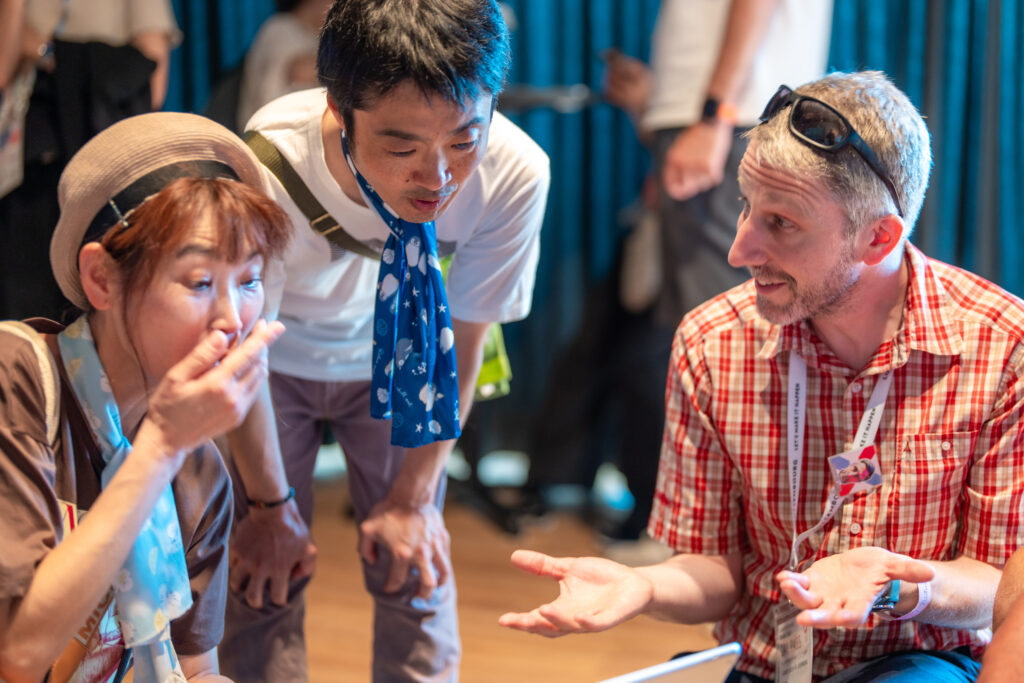
“We were told before coming to Japan that it’s difficult to get in contact with Japanese people because of the language barrier and the culture barrier. At the same time we’ve always been told that it’s difficult to communicate about math. But the activities that we created, we make them as simple as possible in terms of their rules, in terms of their approach.
“This simplicity allows us to create an emotional connection with the Japanese participants that goes beyond what we could have hoped for,” Hugo Parlier adds.

Simple rules, intuitive games
“The first day we came here, I thought, like, nobody will play these games because after having queued, in this heat, who wants to sit down and start doing a brain game? But then, not at all. They were very motivated and very happy to do this, and this was impressive. The games developed so that the rules are very simple. You can explain the rules in less than a minute and the games are very intuitive,” Ann Kiefer explains.
This ManDALA project is an evolution of the approach adopted during ReShape and previous activities presented at the World Expo in Dubai, which the researchers developed as part of The Sound of Data project (with the FNR, LIST and Rockhal) for Esch2022, when Esch was the European Capital of Culture.
A long history of mathematics outreach
Bruno Teheux says “Getting people to participate in mathematics or art may be challenging. Yet merging both disciplines proves remarkably effective at overcoming this obstacle.”
“Building on this initial success, we wish to further develop the use of art in popularising mathematics in order to reach a wider audience.”
In addition to the World Expo in Japan, the project was rolled out at numerous events, including workshops (Girls Exploring Math, YEP Schoulefoire) and exhibitions (EPFL), reaching thousands of people. Coming up is, for example, to have an evolution of the Shapes exhibition in Cercle Cité during the Winter of 2026-27.