BACK TO RESEARCH WITH IMPACT: FNR HIGHLIGHTS
When Jose Luis Sanchez Lopez was featured in Spotlight on Young Researchers in 2019, he was a postdoc in the Automation and Robotics Research Group (ARG) at the SnT of the University of Luxembourg. Seven years later, we caught up with Jose Luis who is now leading a CORE and BRIDGES project at the SnT.
Are you still active as a researcher, if yes, what is your current role?
“Yes, I am currently a Permanent Research Scientist at the SnT-UL, and Deputy Head of its Automation and Robotics Research Group.”
“I am currently a consolidated researcher leading a team of very talented PhD students and Postdocs with great support from the FNR. I am the PI of a CORE Junior project and a BRIDGES project, and I am supervising two PhD students funded by AFR grants. In addition to that, I am actively involved in outreach activities funded and promoted by the FNR, such as the Researchers Days, Science Festival, or Researchers at School.”
Where has your career path taken you since 2019?
“I continued my career in academia. In 2019, I worked as a Research Associate in a temporary position within two FNR-funded research projects. Both projects ended up with great success and very meaningful outcomes, including real-world demonstrations of aerial robotics applications, such as the autonomous visual inspection of airframes of cargo aircraft using drones.”
In 2021, you were promoted to your current role as Permanent Research Scientist, what difference has this made to you?
“This milestone allowed me to operate more independently, secure funding to pursue my research agenda, and begin building my own team. The support from FNR was instrumental in enabling this progression.
“More than five years after this promotion, I have developed an established research profile, reflected in the number, quality, and impact of my publications, and I lead a strong and productive research team. I am grateful for the support received and for the level of autonomy that allows me to effectively pursue my research agenda.”

Broadly speaking, AI is the focus of our research. Which area does your work specifically deal with?
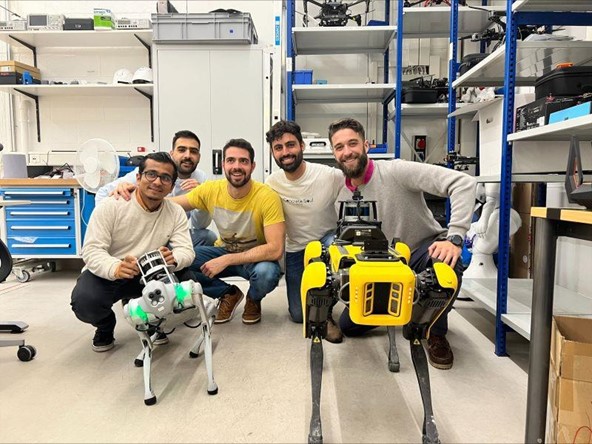
“My research focuses on Embodied AI, with a particular emphasis on Embodied Spatial AI. I develop AI methods that enable embodied agents (i.e., robots, particularly mobile robots, such as legged ground robots, humanoids, or drones) to achieve higher levels of intelligence and autonomy by improving their ability to perceive and interpret themselves, their surroundings, and the broader context in which they operate (i.e., the situation). The goal is to move beyond superficial perception toward a deeper, situational understanding of what is happening in real-world environments.“
“This research is consistently driven by real-world deployment rather than controlled laboratory demonstrations, with current applications in domains such as construction, logistics, and defense.”
Is there any advice you would like to give early-career researchers, or yourself when you started your research career, if you could go back in time?
“Research is deeply rewarding, especially when months or years of sustained effort culminate in a contribution that advances the state of the art, effectively changing the world, even if it is just a little. These moments provide a strong sense of purpose and impact, reinforcing the motivation to continue pushing boundaries.”
“At the same time, the process is very demanding and, at times, frustrating and discouraging. The more you grow in your career, and the more you seek excellence, rejection becomes a more frequent part of the experience. Submissions to top venues or competitive funding calls often have very low success rates, making setbacks more common than positive outcomes. For example, a success rate of 30% means that it is statistically more likely that you fail rather than succeed, and statistically, you will only succeed once every three attempts. Navigating this environment requires resilience, always looking at the big picture and a clear sense of purpose, remembering what your driving forces are and what motivates you, where individual rejections should be viewed not as endpoints, but as necessary steps in a longer process of learning, refinement, and progress.”
Do you see yourself staying in your current career/academia in the next 5 years?
“I am strongly committed to research, particularly within academia, where I can lead my own research agenda, contribute to advancing knowledge, and generate real-world impact, while also collaborating with industrial partners on applied use cases. I also find it especially rewarding in academia to support the development of others and to see, for example, my PhD students grow into independent, recognized researchers and successfully graduate after contributing to the state of the art.”
“For these reasons, I intend to continue my academic career, and it is likely that we will meet again in 5 years for a new Spotlight update. 😊”
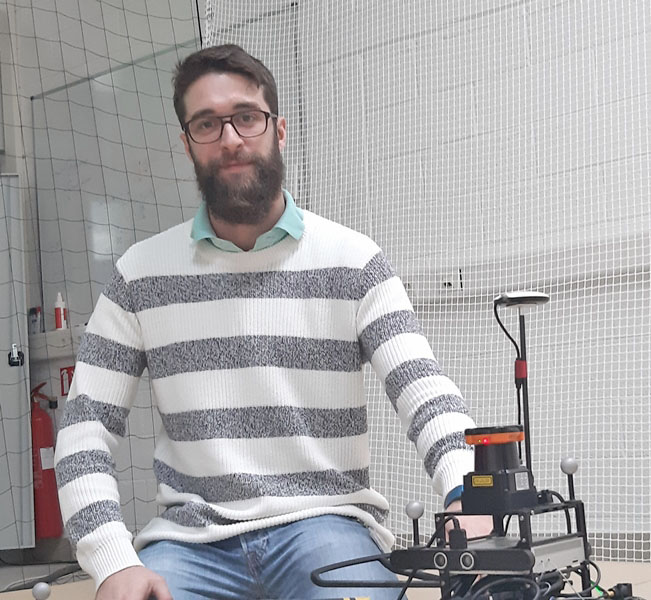
Jose-Luis Sanchez-Lopez works with multirotor aerial robots – drones. Despite being early in his research career, the Spanish national’s research is already taking off, having secured him several awards at international competitions. After completing his PhD in 2017, Jose-Luis set his sights on Luxembourg, where he works as a Postdoc at the SnT at the University of Luxembourg, with the goal of giving drones enough AI that they can safely operate autonomously in a range of environments.
Jose-Luis’s research brings together two hot topics: Artificial Intelligence (AI) and drones. While one’s thoughts can immediately jump to all kinds of science fiction scenarios, giving drones artificial intelligence can enable them to perform tasks that would take significantly longer for humans, but also tasks that would be dangerous or simply not possible for humans.
Drones with AI can, for example, scan the terrain of a construction site, or drop supplies to victims in hard to reach disaster areas. However, there is still work to be done, for example around situational awareness and trajectory planning.
Jose-Luis works in the Automation and Robotics Research Group (ARG) at the University of Luxembourg’s Interdisciplinary Centre for Security, Reliability and Trust (SnT)
From software to drone teamwork
Jose-Luis’s main research goal is to provide aerial robots (drones) with advanced AI, to enable them to achieve a completely autonomous level of operation and in this way expand the list of applications. His research is divided into four areas:
“The first one is the design and development of system and software architectures that consider the requirements of a fully autonomous operation of multirotor aerial robots.
“The second area includes multi-robot approaches for multirotor aerial robots, which take into account the need of combining a set of aerial robots, exploring different methodologies of cooperation, collaboration, and formation, among others.
“The third area relates to semantic situational awareness: providing the aerial robot with rich, accurate and useful information about the environment, by means of classic sensor fusion techniques, combined with novel machine learning techniques. This research enables the navigation of aerial of aerial robots in complex unstructured dynamic environments.
“Finally, my last research area tackles the efficient path and trajectory planning together with the agile control of multirotor aerial robots.”
Jose-Luis’s overall goal is to develop a fully autonomous aerial robot that is versatile enough that it can carry out any mission without restrictions in any environment. There is still work to be done as Jose-Luis explains:
“In order to achieve this, a long way still needs to be covered in fields like versatile systems and software architectures, multi-environment situational awareness, efficient path and trajectory planning together, and agile control of multirotor aerial robots.”
Jose-Luis’s main research goal is to provide aerial robots (drones) with advanced AI
Pushing the boundaries of AI drones
Having completed his PhD in 2017, Jose-Luis is still relatively new to the world of research, but he knows drones: He came in second at the 2012 IMAV (International Micro Air Vehicle Conference), at the 2013 IMAV he scooped first prize, and since then has taken home other awards. During his PhD at the Technical University of Madrid, Jose-Luis also had the chance to get an international perspective, thanks to a six-month research stay at Arizona State University, along with two research stays at the LAAS-CNRS in Toulouse, France.
“During my research career, I have already pushed the boundaries of the autonomous operation of multirotor aerial robots. Thanks to the results of my research, we have managed to develop some fully autonomous applications in some particular environments. My PhD research outcomes were applied to several research, proof of concept, technology transfer and industrial projects with high success and satisfaction of the project funders.”
From Spain to Luxembourg due to better funding opportunities
18 months into being a Postdoc, Jose-Luis explains he has felt many differences compared to when he was a PhD student in Spain:
“When you are a PhD, your main objective is the development of your PhD thesis. I felt all the pressure falling onto me, and the success is highly related to your work. I feel that when you are working as a Postdoc, the personal level fades, and all your work is devoted to the research group you belong to. In addition to this, you are meant to work in a collective way rather than in an individual way, helping PhD students when needed and collaborating with other Postdocs and professors when requested.”
Nonetheless, Jose-Luis PhD work was a huge success, earning his the highest grade and an award for outstanding PhD thesis.
When asked why he decided to leave Spain to continue his research in Luxembourg, Jose-Luis explains that the wealth of funding opportunities for his research were a big factor.
“On a personal level, I love Luxembourg, as it is small and therefore manageable, but at the same time very vibrant and cosmopolitan country with a young university that provides a good opportunity to implement fresh, good ideas that can push your research to a very high level,” Jose-Luis adds.
Jose-Luis has been funded through the FNR CORE project BEST-RPAS (Principal Investigator: Prof. Holger Voos), as well as the FNR POC (JUMP) project AFI (Principal Investigator: Dr. Miguel Olivares-Mendez, who has also been featured in Spotlight on Young Researchers.)
Related highlights
Spotlight on Young Researchers – revisited: “Luxembourg was never in my plans, but now I am happy that I took up the adventure”
When Eva Lagunas was featured in Spotlight on Young Researchers in 2018, she was a postdoc at SnT, working on…
Read more
Spotlight on Young Researchers – revisited: From coal research to the Ministry of the Economy
When Pit Losch was featured in Spotlight on Young Researchers in 2017, he had completed his AFR PhD at the…
Read more
Spotlight on Young Researchers – Revisited: From researcher to project manager
When Xianqing Mao was featured in Spotlight on Young Researchers in 2017, she had completed her medical degree and was…
Read more
Spotlight on Young Researchers – Revisited: From Luxembourg, to Cambridge, France, and an ERC grant
“Would matter be perfect, it would be boring” says Guillaume Nataf, who has an oozing passion for physics and teaching…
Read more
Spotlight on Young Researchers – revisited 5 years later: A post-PhD life in finance
When Eric Finn Schaanning was featured in Spotlight on Young Researchers in 2017, he had just defended his AFR PhD…
Read more
Spotlight on Young Researchers – revisited 5 years later: From drones to space robotics
When we wrote about Miguel Olivares Mendez in the 2017 edition of Spotlight on Young Researchers, the researcher was working…
Read more
Related highlights
25 examples of research with impact: Shaping the future of autonomous robotics
As the FNR marks 25 years since its creation, we highlight 25 examples of FNR-supported research with impact. Since arriving…
Read more
Spotlight on Young Researchers: Giving robots a more human touch
The use of robots is rising, both in industry and in homes. This is made possible by scientists leveraging artificial…
Read more