BACK TO RESEARCH WITH IMPACT: FNR HIGHLIGHTS
When Eva Lagunas was featured in Spotlight on Young Researchers in 2018, she was a postdoc at SnT, working on satellite communications. We caught up with Eva, who is now Assistant Professor and Deputy Head of the SIGCOM research group, the biggest research group at SnT.

You’re still active in research in Luxembourg, how has your career evolved since 2018?
“Later in 2018 I was promoted to a permanent research scientist position, which felt like a big achievement considering how difficult is to obtain job stability in academia. I started getting more responsibilities – more projects granted, more students, more teaching, more people under my guidance, new research lines.
“In 2025, there was an opening for an Assistant professor in Design and Optimisation of Non-Terrestrial Communication Systems, to which I applied, and after few months of evaluation and a presentation of my merits to an evaluation committee, I was given the position. Now, I am Assistant Professor and Deputy Head of SIGCOM research group, the biggest research group at SnT. ”Eva Lagunas
You came to Luxembourg with your family in 2014. When you first arrived, were you planning to build a future here, or did things develop differently than you expected?
“When I arrived, my plan was to stay for 1 or 2 years only, to gain international experience and go back right on time for my son to start the mandatory education in school. My husband came with me with a sabbatical from his former workplace. We made the decision to stay in Luxembourg a bit longer and we only decided to stay here in the long term when we both managed to get stable jobs. Luxembourg was never in my plans, but now I am happy that I took up the adventure.”
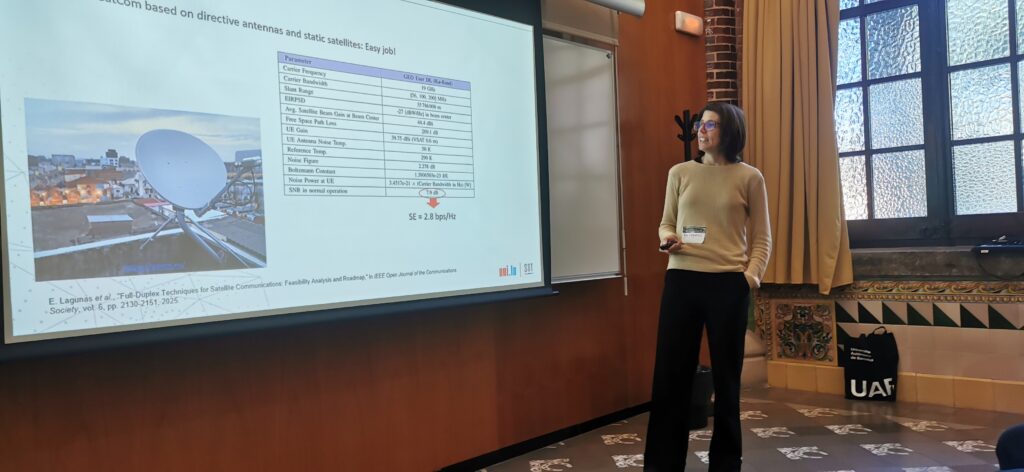
In 2018, your focus was on satellite communications in the 5g era – is the focus of your work the same now or how has it changed?
“Well, my research is still on the same line but it has evolved hand-in-hand with the massive transformation of the space industry, driven by the so-called New Space ventures (e.g. Starlink). In 2018, the 3rd Generation Partnership Project (3GPP) has just published the first technical specifications for cellular system mentioning non-terrestrial networks (NTN).
“After that, the satellite industry has been doing a great effort to push for the integration of NTNs into 5G/6G standards, with the aim to transform their service including satellite direct-to-device, satellite internet-of-things or seamless terrestrial non-terrestrial coverage.
“However, the popularity of low orbiting satellites is confronted by some technical and regulatory challenges: Unlike the geostationary counterpart, these satellites constantly move, creating a highly dynamic scenario. This characteristic fundamentally alters the communication link (Doppler effect, time-varying propagation) and the communication network architecture (inter-satellite links, complex ground infrastructure). The co-existence with other satellite or terrestrial system in terms of spectrum and coverage poses additional challenges.”
“The use of Artificial Intelligence to automate decision-making is such dynamic environment has also gained momentum in recent years. All in all, real-time awareness and fast-executable algorithms become a must, while we shall keep an eye into the satellite SWaP (Size, Weight, and Power).”
Is there any advice you would like to give early-career researchers, or yourself when you started your research career, if you could go back in time?
“Academia is a very competitive work environment. It is true that luck plays a big role in how things can turn out, but it is also true that hard work creates opportunities to “get lucky”. At the same time, I would tell anyone that is important to not only “work hard”, but also to find other things outside work that bring you happiness, such as sports, music, friends, or travelling.”
Do you see yourself staying in your current career in the next 5 years? If yes, how are you hoping your research and your career develop?
“Yes, I visualize myself in academia within the near future. I think I might get more involved in teaching, tutoring more students, and maybe getting new roles in organization committees or technical associations. I am also curious to see how academia will adapt to the wave of AI and its use in research and teaching environments.”
Eva Lagunas has always been curious about technology, even building her own makeshift smartphone when she was a child. A couple of degrees later, the Spanish national set her sights on coming to Luxembourg, family in tow, to take up a Postdoc position at the University of Luxembourg’s Interdisciplinary Centre for Security, Reliability and Trust (SnT). Now, she feels lucky to spend her time researching satellite communications in the 5G era.
“I love playing a part in designing the wireless communications of the future”, Eva Lagunas says.
Wireless communications are constantly evolving, and almost every device now has its own built-in wireless internet connection. Efforts to increase the speed of these networks will soon see the roll-out of 5G – a wireless broadband technology like the 4G found on most smartphones, but faster and with better coverage.
Making 5G efficient
However, this also brings about a couple of issues that research is trying to solve: How can we avoid congestion and ensure that the data travels across the network as fast as possible?
These are some of the questions Eva is tackling in her research. Having worked on various projects funded by the FNR’s CORE and INTER programme, Eva looks at how 5G can be made efficient, both in its use of energy, but also in the rate at which information is transmitted over a given bandwidth.
Improving 5G support infrastructure
One of the challenges in solving this issue is the need to improve capacity of the underlying backhaul network – the infrastructure responsible for transporting communication data from end users or nodes to the central network or infrastructure and vice versa. As part of a project funded in the FNR’s 2017 CORE Call, Eva is exploring solutions, she explains:
“I am investigating the concept of a seamlessly Integrated Satellite-Terrestrial Backhaul Network, capable of jointly exploiting the terrestrial and satellite links, depending on the traffic demands.”
Eva explains that satellite communications have been identified as a promising wireless backhaul solution to complement the terrestrial backhaul infrastructure:
“Satellite backhaul offers a solution not only for remote and difficult-to-reach locations, but also in terms of data off-loading for delay-tolerant traffic from the terrestrial network and as an alternative routing path in case of terrestrial link failure or congestion.
“Moreover, satellite systems have always played a key role in content distribution and therefore, they are expected to be fundamental components of the information-centric networking.”
Collaborating with industry
In addition to her work looking at using satellite communications to improve the support structure of 5G, Eva is also involved in a Horizon 2020 (H2020) project, funded by the European Commission, which is also a unique experience for her:
“The H2020 project (SANSA) allows me to collaborate with highly qualified professionals from both academia and industry. It’s exciting to see how research ideas can be transformed into potential technological solutions of interest for our industrial partners.”
Passionate about technology from a young age
Women in tech research are far from abundant, but for Eva it was clear that this was the direction she wanted to go in:
“I have always been curious about technology. I remember building my own smart phone when I was a child! I’ve known that telecom engineering would be my topic as far back as I can remember, and that I would pursue a PhD. Research wasn’t my only motivation: I have always been interested in teaching and mentoring students as well.”
Choosing Luxembourg for its reputation
Eva, a Spanish national, explains she actively chose to come to Luxembourg to join SnT’s SIGCOM group because of its reputation in the field of wireless communication research, an area where Luxembourg has made a name for itself in the international community.
Along with her husband and their then 1-year old with her, Eva relocated to Luxembourg in 2014. The three of them have, since then, happily settled in and also welcomed a new family member. Outside of work, Eva also plays for a local football club, which she says not only helps her integrate and make local friends, but is also a great aid in learning Luxembourgish and French.
Eva (right) also plays for her local football club
Related highlights
Spotlight on Young Researchers – Revisited: From drones to embodied AI
When Jose Luis Sanchez Lopez was featured in Spotlight on Young Researchers in 2019, he was a postdoc in the…
Read more
Spotlight on Young Researchers – revisited: From coal research to the Ministry of the Economy
When Pit Losch was featured in Spotlight on Young Researchers in 2017, he had completed his AFR PhD at the…
Read more
Spotlight on Young Researchers – Revisited: From researcher to project manager
When Xianqing Mao was featured in Spotlight on Young Researchers in 2017, she had completed her medical degree and was…
Read more
Spotlight on Young Researchers – Revisited: From Luxembourg, to Cambridge, France, and an ERC grant
“Would matter be perfect, it would be boring” says Guillaume Nataf, who has an oozing passion for physics and teaching…
Read more
Spotlight on Young Researchers – revisited 5 years later: A post-PhD life in finance
When Eric Finn Schaanning was featured in Spotlight on Young Researchers in 2017, he had just defended his AFR PhD…
Read more
Spotlight on Young Researchers – revisited 5 years later: From drones to space robotics
When we wrote about Miguel Olivares Mendez in the 2017 edition of Spotlight on Young Researchers, the researcher was working…
Read more