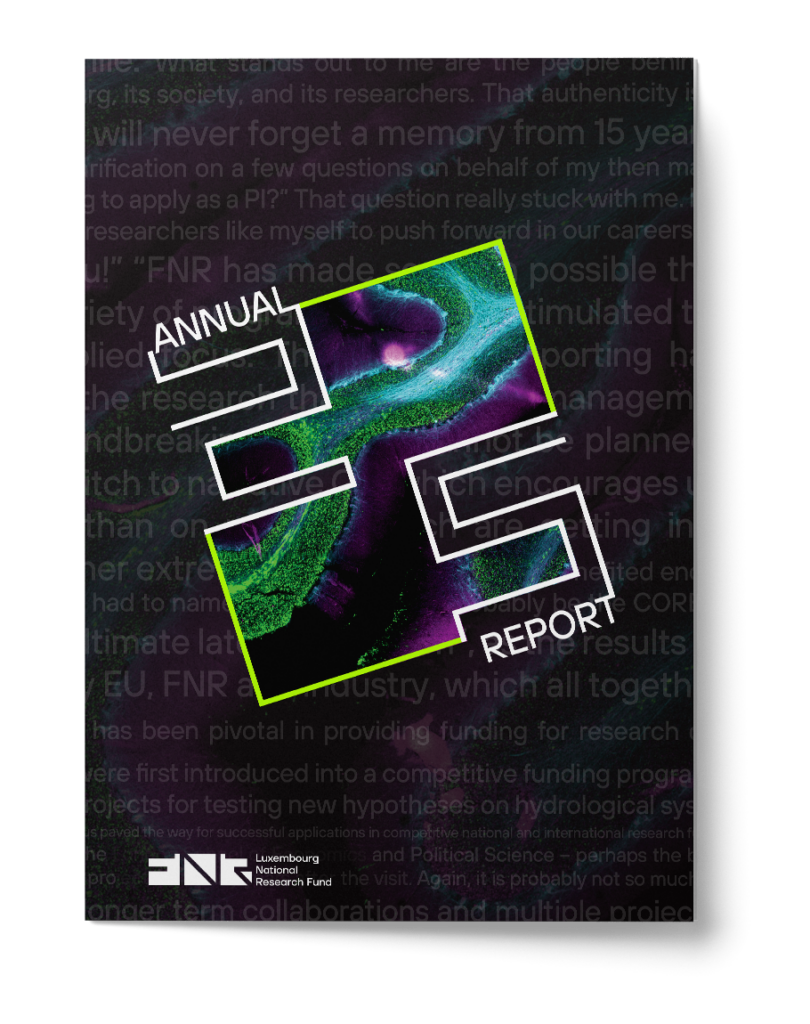
The Luxembourg National Research Fund (FNR) today publishes its Annual Report 2025. Alongside the year’s funding figures, the report features twenty-five first-person accounts from researchers based in Luxembourg, looking back at how successive FNR grants, often awarded years apart and across different programmes, shaped the work they have been able to do.
The Annual Report 2025 closes the 2022-2025 Performance Contract between the FNR and the Ministry for Research and Higher Education. In 2025, the FNR committed 95.92 million euros in new funding to 238 projects, drawn from 931 evaluated submissions. Across all programmes since 2008, total commitments now stand at 1.265 billion euros.
To mark twenty-five years since the law creating the FNR was passed in 1999, the report sets aside its usual annual format for one section and gives the floor to the researchers themselves. Twenty-five portraits, drawn from interviews conducted during the anniversary period, trace careers built on FNR support. The full set is available on fnr.lu.
A pattern runs through the accounts. Researchers rarely point to a single decisive grant. They describe sequences of projects, often spanning a decade or more, in which one piece of FNR-funded work created the conditions for the next, and the next opened doors to European or industrial funding.
Four accounts from the report
Djamila Aouada, Deputy Director of SnT at the University of Luxembourg, has been a researcher in Luxembourg for seventeen years. Her group’s work on human body modelling has produced a dataset of over three thousand body scans, collected from Luxembourg residents under GDPR-compliant conditions and shared with more than two hundred institutions internationally. The same group also works on deepfake detection.
Emmanuel Defay, Head of the Smart Materials Unit at LIST, traces a clear arc in his contribution to the report. A 2010 PRIDE doctoral training grant (MASSENA) enabled him to work for the first time with a PhD student on electrocaloric cooling, resulting in a 2020 Science publication. A subsequent BRIDGES project (CECOHA) involved a Japanese industrial partner. A CORE project (THERMODIMAT) led to a 2024 paper in Nature on waste-heat conversion, and that work was decisive in his securing an ERC grant later the same year. Each step relied on what came before.
Christiane Hilger has led research on allergic diseases at the Luxembourg Institute of Health since 1992. Over twenty years of sustained work, her team has identified, characterised and produced more than thirty allergens from animal sources. Several are now in use for molecular IgE diagnosis, improving accuracy and informing dietary advice for patients.
Tom Wirtz, who heads the Scientific Instrumentation and Process Technology unit at LIST, describes a similar pattern with a different shape. A 2010 CORE project on Helium SIMS, a technique for high-resolution elemental imaging, was the starting point for a sequence of follow-on projects funded by the EU, the FNR, and industry, which together considerably expanded his unit’s research and development activities. In his telling, the FNR’s role was to back work that was still risky at the point of first funding.
The full series covers researchers at the University of Luxembourg, LIH, LIST and LISER, working across the four National Research Priority areas: Industrial and Service Transformation, Personalised Healthcare, Sustainable and Responsible Development, and 21st Century Education. The breadth of fields represented, from cancer research and pain treatment to artificial intelligence, digital history and environmental science, reflects the range of work the FNR supports.
“What you read in these twenty-five stories is something the annual figures cannot show on their own. Researchers describe results that took ten, twenty, sometimes thirty years to come together, and they describe them as the product of successive grants, not single ones. Funding one good project rarely produces one good outcome. It produces the conditions for the next project and the one after that. Public research funding is patient by nature, and the patience is part of what makes it work.“
Dr Isabelle Mossong, Secretary General of the FNR
Related highlights
25 examples of research with impact: Shaping the future of autonomous robotics
As the FNR marks 25 years since its creation, we highlight 25 examples of FNR-supported research with impact. Since arriving…
Read more
25 examples of research with impact: Driving innovation in software engineering, security, and AI
As the FNR marks 25 years since its creation, we highlight 25 examples of FNR-supported research with impact. Since arriving…
Read more
25 examples of research with impact: A solid foundation for artificial intelligence
As the FNR marks 25 years since its creation, we highlight 25 examples of FNR-supported research with impact. Artificial intelligence…
Read more
25 examples of research with impact: Advancing AI and Computer Vision: From space tech to better healthcare
As the FNR marks 25 years since its creation, we highlight 25 examples of FNR-supported research with impact. Since arriving…
Read more
25 examples of research with impact: Securing online services
As the FNR marks 25 years since its creation, we highlight 25 examples of FNR-supported research with impact. In the…
Read more
Related highlights
25 examples of research with impact: From metabolic insights toward personalised treatment
As the FNR marks 25 years since its creation, we highlight 25 examples of FNR-supported research with impact. Since arriving…
Read more
25 examples of research with impact: Breaking barriers in cancer research & treatment
As the FNR marks 25 years since its creation, we highlight 25 examples of FNR-supported research with impact. In Luxembourg…
Read more
25 examples of research with impact: Towards early detection and prevention of neurodegenerative diseases
As the FNR marks 25 years since its creation, we highlight 25 examples of FNR-supported research with impact. Since arriving…
Read more
25 examples of research with impact: On the trail of allergies
As the FNR marks 25 years since its creation, we highlight 25 examples of FNR-supported research with impact. Over the…
Read more
25 examples of research with impact: Unravelling the secrets of microbiomes
As the FNR marks 25 years since its creation, we highlight 25 examples of FNR-supported research with impact. Since returning…
Read more
Related highlights
25 examples of research with impact: Harnessing nature’s power for a sustainable future
As the FNR marks 25 years since its creation, we highlight 25 examples of FNR-supported research with impact. Since arriving…
Read more
25 examples of research with impact: Cultivating innovation – Harnessing cannabis and plant cells for a sustainable future
As the FNR marks 25 years since its creation, we highlight 25 examples of FNR-supported research with impact. Since arriving…
Read more
25 examples of research with impact: Life Cycle Assessment – environmental assessment of materials, products, technologies and policies
As the FNR marks 25 years since its creation, we highlight 25 examples of FNR-supported research with impact. Since 2006,…
Read more
25 examples of research with impact: A better understanding of rivers and their watersheds
As the FNR marks 25 years since its creation, we highlight 25 examples of FNR-supported research with impact. Starting with…
Read more
25 examples of research with impact: A geographical approach to a sustainable society
As the FNR marks 25 years since its creation, we highlight 25 examples of FNR-supported research with impact. One of…
Read more
Related highlights
25 examples of research with impact: Smart materials for a sustainable future
As the FNR marks 25 years since its creation, we highlight 25 examples of FNR-supported research with impact. Since arriving…
Read more
25 examples of research with impact: Revolutionising nano-analytics for a complex world
As the FNR marks 25 years since its creation, we highlight 25 examples of FNR-supported research with impact. Since arriving…
Read more
25 examples of research with impact: Next generation solar cells
As the FNR marks 25 years since its creation, we highlight 25 examples of FNR-supported research with impact. Since arriving…
Read more
25 examples of research with impact: The endless potential of plasma
As the FNR marks 25 years since its creation, we highlight 25 examples of FNR-supported research with impact. Over the…
Read more
25 examples of research with impact: Innovation beyond solid, liquid or gas
As the FNR marks 25 years since its creation, we highlight 25 examples of FNR-supported research with impact. Since arriving…
Read more
Related highlights
25 examples of research with impact: The science of fairness – inside inequality
As the FNR marks 25 years since its creation, we highlight 25 examples of FNR-supported research with impact. Since arriving…
Read more
25 examples of research with impact: Understanding the evolution of the workplace in the digital era
As the FNR marks 25 years since its creation, we highlight 25 examples of FNR-supported research with impact. Active in…
Read more
25 examples of research with impact: Shaping the future of historical research in a digital age
As the FNR marks 25 years since its creation, we highlight 25 examples of FNR-supported research with impact Andreas Fickers…
Read more
25 examples of research with impact: Understanding human thinking
As the FNR marks 25 years since its creation, we highlight 25 examples of FNR-supported research with impact. Since returning…
Read more
25 examples of research with impact: Towards historical literacy
As the FNR marks 25 years since its creation, we highlight 25 examples of FNR-supported research with impact. Over the…
Read more