The Government and the Luxembourg National Research Fund (FNR) have signed the multiannual agreement for 2026–2029. For the implementation of the activities covered, the Government authorises the FNR to commit up to EUR 362 million over the period. The agreement forms part of the recently updated National Research and Innovation Strategy and confirms the FNR’s priorities for the next four years: excellence, impact and the integration of research into society.
The Government and the Luxembourg National Research Fund (FNR) have signed the multiannual agreement for 2026–2029, which sets out the framework for the FNR’s missions, objectives and resources for the next four years, together with the associated objectives and indicators.
For the implementation of the activities covered by this agreement, the Government authorises the FNR to enter into commitments up to an overall ceiling of EUR 362 million over the next four years, broken down as follows:
EUR 84.0 million (2026), EUR 88.2 million (2027), EUR 92.6 million (2028) and EUR 97.2 million (2029).
These amounts represent commitment ceilings: they define the maximum level of commitments that the FNR can make. They are to be distinguished from payments, which are made progressively as projects are implemented. The ceiling covers the funding instruments managed by the FNR as well as its operating costs.
The agreement forms part of the Government’s National Research and Innovation Strategy. This strategy prioritises industrial and services transformation, personalised health, sustainable and responsible development, and 21st‑century education, and integrates topics that have become essential, such as data, artificial intelligence, and quantum technologies, in connection with the initiative “Accelerating Digital Sovereignty 2030”. It also takes account of the growing strategic role of research in the defence sector, as well as the increased focus on research security in a changing geopolitical context.
From 2026 to 2029, the FNR will implement its strategic priorities around three objectives: supporting excellent research aligned with national priorities, strengthening knowledge exchange and societal impact, and consolidating strategic intelligence and ecosystem integration.
This trajectory marks a deliberate shift: greater strategic alignment, increased ambition in terms of impact (including through mission‑oriented projects), a stronger focus on collaboration with economic and societal stakeholders, and the development of anticipatory and coordination capacities serving the entire ecosystem.
“This agreement provides us with the visibility we need to plan and deliver on our commitments, to fund excellence and to strengthen the contribution of research to the country’s priorities. Our ambition is simple: to invest at the highest level, accelerate impact and consolidate the conditions that enable research to serve Luxembourg sustainably,” said Dr Isabelle Mossong, Secretary General of the FNR.
“In a scientific and geopolitical environment that is accelerating, the challenge is twofold: to preserve excellence while ensuring that research delivers tangible benefits for society. This agreement reinforces the role of the FNR as a funding agency, but also as an actor of integration and evaluation in support of a public policy based on quality and transparency,” emphasised Martine Reicherts, Chair of the FNR Board of Directors.
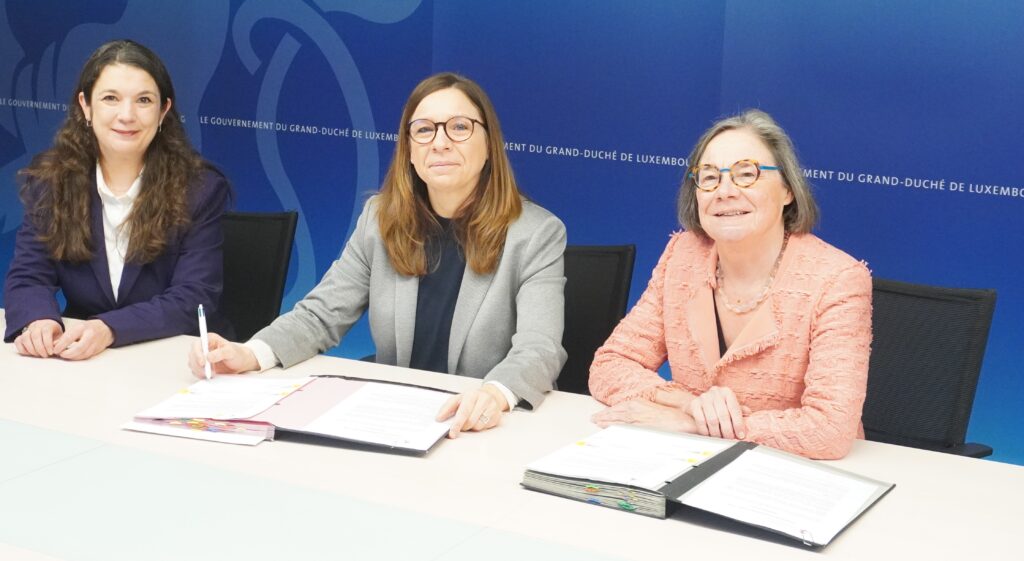
Left to right: Isabelle Mossong (FNR Secretary General); Stephanie Obertine (Minister for Research & Higher Education); Martine Reicherts (Chair of the FNR Board of Directors)