PROGRAMME SUMMARY
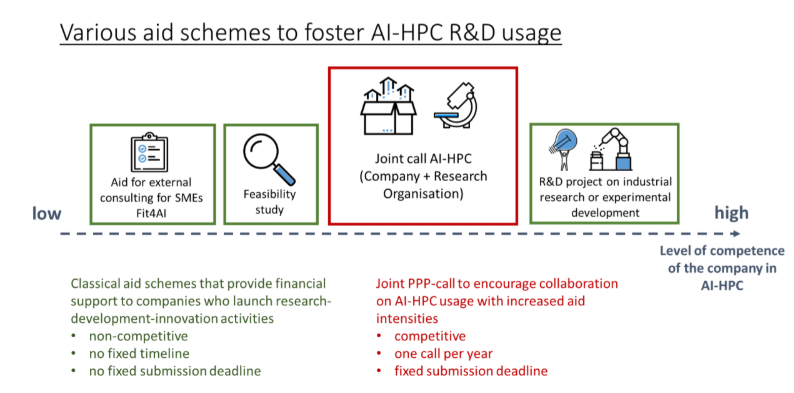
The Luxembourg Ministry of the Economy, the Luxembourg National Research Fund (FNR), and Luxinnovation have launched a joint funding call supporting consortia of private companies and public research institutions to conduct R&D projects in data analytics, AI, and/or quantum technologies.
Context of the call: Digital sovereignty is a key government priority. HPC enables faster, more accurate analysis of large datasets and reduces R&D costs through simulation. AI — spanning machine learning, computer vision, and NLP — helps companies automate tasks, improve predictions, and make better decisions. Quantum technologies open new possibilities in optimisation, materials discovery, and secure communications, though widespread industrial adoption is still years away. The national AI Factory supports these ambitions by centralising resources and fostering collaboration.
Purpose of the call: To accelerate the integration of data-driven innovation, AI-based solutions, and quantum technologies into companies’ R&D processes, and to stimulate the creation of new applications and services leveraging these technologies.
Objectives: The call aims to bridge public research and industry for mutually beneficial applied R&D outcomes. Specific goals include fostering strong public-private partnerships, strengthening companies’ expertise in advanced data processing, AI, and quantum technologies, contributing to Luxembourg’s economic development and digital sovereignty strategy, and enhancing Luxembourg’s reputation as an innovation hub.
Call topics
Projects submitted under this call must be innovative, of the highest quality, and contribute meaningfully to the development of Luxembourg’s economic landscape. They should demonstrate a positive and sustainable impact by diversifying or strengthening the future business activities of companies, while simultaneously enhancing their R&D capabilities, knowledge base, and technical expertise. Moreover, the projects should clearly build upon the state of the art, demonstrate scientific excellence, and contribute to the creation of new scientific knowledge. Eligible projects may fall within the categories of industrial research and/or experimental development as set out in the RDI law [1].
The R&D projects should address complex and forward-looking challenges, resulting in new solutions or services that either outperform existing technologies or significantly accelerate their development. Projects must also tackle key issues relevant to industry, science, or society at large. Applicants are required to clearly justify the integration of data analytics, AI and/or quantum technologies, and demonstrate how their proposed products, processes, or services will benefit from these innovations.
This joint call focuses on R&D initiatives in Data, Artificial Intelligence (AI) and Quantum Technologies, that are aligned with national strategic priorities in research and industry, as well as with the recently published strategic initiative « Accelerating Digital Sovereignty 2030 ». The following thematic application areas are defined:
1) Data-based solutions for advanced simulations and analytics
This area targets projects leveraging the opportunities of big data and potentially the computing power of HPC to simulate, analyse, and interpret complex systems across domains, accelerating innovation in science and industry.
- Large-scale simulations (e.g. Computational Fluid Dynamics (CFD), Finite Element (FE) analysis) for engineering design, materials science, and environmental applications
- Big data analytics and visualisation techniques applied to vast datasets for industrial or scientific insights
- Advanced predictive modelling and forecasting of complex systems
- Curation and preparation of relevant datasets, including the generation of synthetic data
- Innovation in data management, among others related to infrastructure, privacy preservation for sensitive data and sharing
- Development of quantum and hybrid algorithms for industrial applications in areas such as optimisation, materials discovery, or machine learning, running on quantum computing infrastructures or on quantum simulators executed on classical HPC systems.
- Research in control, error mitigation/correction, compilation, and hybrid workflows aimed at increasing software maturity.
2) Artificial Intelligence (AI) for industry and scientific innovation
This topic area supports the development and application of AI technologies to improve industrial processes, enable scientific breakthroughs, and create intelligent systems that drive innovation.
- Machine learning-driven as well as multimodal AI-based solutions to optimise industrial processes
- AI-based automation, including pattern recognition, predictive maintenance, and computer vision
- AI-powered decision-support to address complex industrial and scientific problems, including the development of domain-specific foundation models, physics-informed AI and AI agents
- AI-enhanced control engineering for autonomous systems, including the development of real-time and edge AI-based solutions
- Innovation in trustworthy and sustainable AI, including developments in frugal AI
3) Quantum technologies for advanced computing and secure communication
This topic area supports research and innovation activities that leverage the potential of quantum technologies in the following domains:
- Quantum computing software and algorithms, quantum simulation for solving high-complexity industrial and scientific problems
- Quantum communication networks and quantum cryptography for secure data transmission in mission‑critical applications. This includes, for example, research and innovation activities in: network components and protocols, integration with classical telecommunication infrastructures, security aspects and interoperability, quantum key distribution, multi-user networks, quantum repeater, and entanglement-based quantum networks.
Timeline

Eligibility criteria and further information about the joint call can be found on research-collaboration.lu.
Webinar 5 March 2026
A information webinar will take place on 5 March 2026, from 11:00 – 12:00 CET. Find out more / register
FUNDING & DURATION
- The FNR will fund the costs of the eligible research organisations in Luxembourg, up to 500.000 € per project, covering all project-specific costs. The Ministry of the Economy will co-finance costs borne by Luxembourg eligible companies up to 700.000 € per project, using the R&D aid scheme. It is expected that the projects will be considered as industrial research and/or experimental development projects. In this case, the maximum co-financing rates for companies through collaboration are as follows:

Project durations are targeted for a 24 to 36 months period. Upon justification regarding their liquidity needs, the Ministry of the Economy may give a 30% upfront payment to SMEs leading a project selected in this Joint Call. For public research organisations FNR financial regulations apply. Self-funded international or national partners are permitted to participate in the consortium.
APPLICATION INFORMATION
To facilitate the emergence of projects and to support interested actors in their efforts, Luxinnovation, the national agency for the promotion of innovation, has set up an online platform where companies and public research actors are invited to submit their project outline.
The submission and evaluation process is structured in two phases:
- The first phase, open from 1 March to 1 April 2026 at 14:00, requires the submission of a Project Outline. This outline will be used to verify eligibility, alignment with the call’s objectives, and the relevance of using data, AI and quantum technologies.
- Following this initial assessment, selected consortia will be invited to submit a Full Project Proposal between 30 April and 1 July 2026 at 14:00. The proposals will then be evaluated by an independent expert panel on scientific, technical and economic criteria, and funding decisions will be communicated by October 2026.
Through this joint call, the Ministry of the Economy, the FNR and Luxinnovation reaffirm their commitment to fostering applied research, encouraging strong public‑private partnerships and promoting the development of new technological capabilities that will shape Luxembourg’s future innovation ecosystem.